Sudoku
Freshly generated boards with a single valid solution. Notes, error check, timer.
Where these puzzles come from
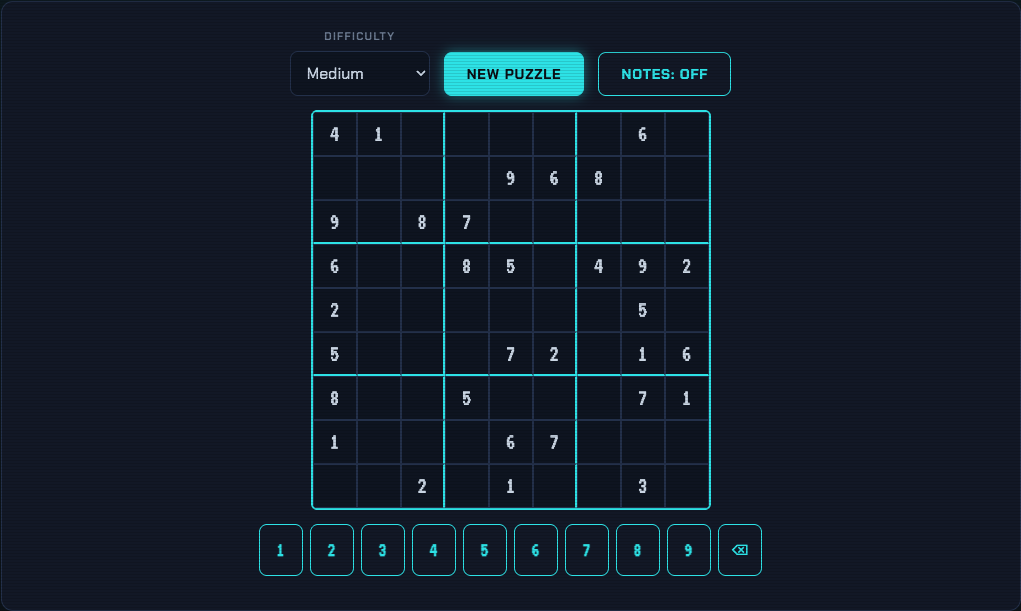
Every board is generated in your browser the moment you ask for one. The generator first builds a complete valid grid using randomized backtracking, then removes clues one at a time in random order. Before each removal sticks, a solver checks the remaining puzzle, and if more than one solution has become possible the clue goes back. The result is a guarantee worth spelling out: every puzzle here has exactly one solution, so pure deduction always suffices and you will never be forced into a coin flip between two valid endings.
Difficulty is set by how many clues survive: easy aims for about 40 givens, medium about 32, hard down around 28. Fewer clues mean longer deduction chains, not different logic. The timer starts when the board appears, and only medium solves record a personal best time, so your saved best always compares like with like.
Using the tools without spoiling the solve
The error check is deliberately weak, in the good sense. A red number means it conflicts with something currently on the board, a duplicate in its row, column, or box. It does not mean the number disagrees with the final solution. You can place a wrong-but-consistent digit and the board will stay quiet about it until the contradiction surfaces, exactly like paper. What the red does catch is slips, the 7 you dropped into a row that already had one.
Notes mode turns the number pad into a candidate marker: tap digits to toggle small pencil marks in the selected cell, and entering a real number wipes that cell's notes. The keyboard works throughout, 1 through 9 to enter and backspace to erase. A habit worth stealing from fast solvers: on medium and hard, do not note every candidate in every cell. Note only the cells where you have narrowed to two candidates. Full-board noting takes minutes and buries the signal; pairs are where the deductions actually fire, and when any pair resolves, its partner cell resolves with it.
What counts as a good time
That depends on you a week ago, which is why the best-time box tracks medium only. As a rough shape: easy boards here reward scanning speed, medium starts requiring pointing pairs and box-line eliminations, and hard, in the high-20s clue range, occasionally wants a deeper chain. Guessing is never required on easy and rarely the right move on hard, since a wrong guess on a unique-solution puzzle can burn several silent minutes before the contradiction shows.
Honest notes on the implementation
Clue counts are targets, not exact promises; the remover walks the board once, so a stubborn grid can end a clue or two above target. The win check compares your board to the generated solution, filled but wrong shows a nudge and highlights any conflicts rather than declaring victory. There is no hint button, no auto-notes, and no undo history, which is a choice: the tools catch mechanical slips and stay out of the logic. Puzzles are not numbered or shared, each generation is one of an astronomically large space, so you cannot replay yesterday's board. Times and your medium best live in your browser only. And because generation happens locally, a new puzzle costs nothing and is always one click away, which is dangerous knowledge on a work night.
Frequently asked questions
Are these real single-solution puzzles?
Yes. Each board starts from a full valid grid, then clues are removed only while a solver confirms exactly one solution remains. Guessing is never required on easy and rarely on hard.
What makes a puzzle easy or hard here?
The number of starting clues: easy keeps around 40, medium about 32, hard drops to the high 20s. Fewer clues force longer deduction chains.
How do pencil notes work?
Toggle notes mode and tap numbers to mark candidates in a cell. Entering a real number clears that cell's notes. Notes are visual aids only; the checker ignores them.
Does the error check spoil the puzzle?
It only flags numbers that conflict with the current board (same row, column, or box), not numbers that merely differ from the final solution, so it catches slips without solving anything for you.